Saturday, January 30, 2016

Somebody Come And Play: Musings on the Art of Sesame Street

If you grew up in the early 1970's you no doubt were raised on what was a new and innovative show at the time, Sesame Street. 

At the time, most moms were staying home with their children, and while preschool was an option, the majority of three and four year olds stayed home until their first day of kindergarten at five or six.  For children in poorer, urban areas, preschool was even less of an option.  But that didn't mean they didn't learn!  For these children, in fact, for all of us kids and our moms, Sesame Street was a lifeline; broadcasting on public television daily.
The original cast of Sesame Street; November 1969


The project was conceived in the late 1960's in an attempt to use the "addictive" nature of television to enhance the learning of young children; especially those in urbanized, low income areas.  The show was ground breaking, in that it zeroed in on this previously overlooked-by-television population of youngsters; helping to bolster the grasp of the English language for Hispanic kids and yet broad enough to be appealing and educational for children of all backgrounds and cultures in the US. 

Originally the concept was to write the show for young children, but also appealing to a broader audience.  Guest stars added a touch of sophistication (somewhat of a wink over the heads of the kids to the viewing parents )  and "artsy" animated  clips held the attention of older children and even adults; encouraging families to watch it together (since older kids and adults tended to control the TV!)  

Popular adult comedienne Lily Tomlin and her famous "Edith Ann" character

Some of the most lovely songs of the 1970's were composed for the show by Joe Raposo, a Portuguese-American composer (also known for composing the theme song to Three's Company and working on the music for the off-Broadway show You're a Good Man, Charlie Brown).   Several of his songs from the show crossed over to adult audiences and were recorded by popular artists.  When The Carpenters recorded his "Sing", it hit #3 on the Billboard charts for a single in 1973.  
The first album of songs from the show was launched and was hugely popular.   Today, many of us remember this album as a staple in their LP collection growing up!


 Raposo's sweetly simple and often poignant and thoughtful lyrics touched the souls of children,  whose daily viewing numbers reached into the millions by the mid 1970's.  

Even melancholy songs like "Bein' Green" let children know that it was okay to be different, without getting preachy, but by simply by letting them surmise it from the song's lyrics.  The early years of Sesame Street seemed to be held together by the golden thread of "present the material in an artistic and interesting way, and kids can figure out a lot more than we've given them credit for".

When the character who played Mr Hooper, Will Lee, died suddenly of a heart attack in 1982, the producers of the show decided to tackle this fact of life head-on for kids.  Rather than recasting the role (something children certainly would notice), they addressed the death head on, right on the show, without mincing words or emotions.  It was one more example that the show,  as originally conceived, made the assumption that children were thinking human beings, able to comprehend much more than previous children's television shows had been willing to give.   (Come on, are you not moved to tears seeing Bob's grief here??)  


The show also featured something new to television; Jim Henson's "Muppets".  Puppets were nothing new to television (think Howdy Doody) but the Muppets, originally called the "Anything People", were different because they were not racially distinct - in fact, they usually weren't even species-distinct.   (Hence the name "Anything People" - "they can be anything").   Friendly monsters let children know that not all monsters are scary.  In fact, they can even be lovable and afraid.  Who remembers this awesome book?  Children delightfully turned pages as Grover broke the "fourth wall" and talked (and yelled) directly at children, instructing them not to reach the end of the book because of his fear.  Of course when we arrive at the end of the book, the monster he has feared is only himself.


Muppets with orange, blue, red and yellow faces gave children the message that people of all colors, shapes and sizes are equal and that people are not to be feared if they look different.  Characters like Oscar the Grouch helped children know that we can treat someone well even if they are unpleasant.  Characters with clashing personalities like Bert and Ernie subtly taught kids, without slapping them in the head with it, that not everyone thinks alike but we can get along.  

Of course, the characters didn't always look like the ones we are familiar with today.  Oscar was originally orange...as seen in this first version of "I Love Trash" from 1969.


And consider what Big Bird originally looked like.  Admittedly, there is at least one thing that has improved over the decades; the size of Big Bird's head.   

Several toy companies launched lines of products for eager children.  One of the best, highly sought after today, is Fisher Price's Sesame Street "Apartments".  This early set featured classic Sesame Street graphics, a chalk board between the buildings and specially made little people in the shape of the classic characters.  


Toy lines of character puppets were very popular with young kids.
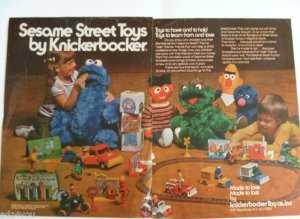
I remember my brother having an amazingly simple Cookie Monster puppet that could actually eat cookies (by a slit in the back of the mouth, into the open hand of the child!)  No need for a "talking Elmo", just a simple hand puppet and a kid was happy!  

So I mentioned it to him, and he says my nephew still plays with Cookie and he sent me this picture.  Looks like Cookie's appetite is still going strong nearly 40 years later!   

And "back in the day" we had no VCR's or Ipads, so, our parents got us these -  a small handheld movie camera that you looked into and turned the handle and you could watch small, silent clips of your favorite Sesame Street episodes!  Lasting only seconds long each, I can still recall playing the film of the guy with the birthday cake falling down the stairs - backwards and in slow motion over and over .  (Thanks Fisher Price! Whoever thought of putting a "reverse" on the crank was ingenious!)  


The show continued to soar in the decades to follow, and when many of us had children in the 1990's we tuned back in, hoping to see the classic shorts such as this one, featuring Jim Henson's daughter featuring a dollhouse he built himself for her.  The segment was shot in her bedroom and the cats were the pets of the Henson family.    (Don't you just love everything about that??)  


Upon tuning in for our children,  we found that the show now consisted mainly of the hugely popular "Elmo",a baby-talking red monster with a sing-song shrill voice and no grasp of how to use personal pronouns, and even worse, characters like "Baby Bear"whose speech impediment left parents wondering if this was a show to help their toddlers and preschools grasp language and vocabulary or an adult's version of what was "cutesy" and commercialized.  Clips such as the one above were considered "dated" looking. 

By the 2000's many parents were disgusted with Sesame Street's dumbed down characters, watered down content and lack of the early artistic flair that distinguished the show from previous children's programming.

Enter the internet.  It wasn't long before classic clips began to surface on Youtube.  Classic clips like the one below from 1972.


 I know it looks like a 70's acid trip and the ending is kinda creepy, but as a child, this one fascinated me with its colorful Monty Python type animation!  Approaching 450,000 views on Youtube, it's proof that grown up kids remember it so well  from their early childhoods and went searching for it again!

Whole Youtube channels launched classic Sesame Street episodes and memorable clips.  In the "early days" we'd sit, with tots on our laps, in front of desktop monitors, singing along with our favorites!
(The "Queen of Six" -1970 stop action animation.  Background is painted cardboard; the puppet's skirt was created with a lampshade)  

These days, tots with Ipads and kiddie tablets now have at their fingertips, tons of early Sesame Street episodes and music clips, sharing with parents and now even grandparents, what we all grew up with!

Below are a few of my favorite early Sesame Street clips with some little known and fun facts about each.  Enjoy!
-------------------------------------------------------- Original Season One Intro, featuring the classic "Can You Tell Me How To Get To Sesame Street?"  


One of my all time favorites "It's Springtime".  I was never clear if this was a kid or a pig in clothes. 


The falling baker!  


"The One-Two-Three Ball".  In this version, is Jim Henson's daughter Heather, again.   This was Frank Oz's directorial debut - it took him four days to build this ball raceway.


A little know fact though, is that this was originally shot with the ending shown below.  Apparently it was too distressing to children that the ball gets ground up in the end, (by Frank Oz's son) so they reshot the ending as shown above, with Heather and the ice cream! 


   One of the catchiest songs ever on the show, the Alligator King!  Recorded by jazz musician Turk Murphy, the song originally had the ending of "I got it on sale at Monkey Ward's (apparently a slang term for Montgomery Ward).  The lyric was changed to "discount store" possibly for legal reasons.


   "Somebody Come And Play".  A poignant song that most certainly struck a cord in every child at one time or another.  "I want somebody to play with".  For adults, the sweetly sad lyric "Somebody come before it's too late to begin" reminded them of the brevity of their children's and their own, childhoods.  (The song was reused many times on the show, but this is the original version, showing a lonely orangutan in a really pathetic zoo.)

These are just a few of the many classic Sesame Street clips available on Youtube.   It's  a great place to seek out your favorites! 

------------------------------------------------------------------------------------------------------------------------
Kelly Wenarsky is the owner of Suburban Treasure, an online shop with an ever-changing stock of all things nostalgic, retro toys and related fun!  Come and play with us!   https://www.etsy.com/shop/suburbantreasure?

Thursday, December 31, 2015

 
Have you seen this video?  It's circulated on social media and is actually a lot of fun.  For those of us who grew up in from the 50's to the 1980's, it was our childhood.  We had the best toys that could never be made today!  

For instance, who remembers these guys?  

All those years we played with them, and we never understood that in actuality, they were an army, bent to kill us all! 

Yes, in 1990, Fisher Price ceased production of all the timeless "Little People Play Family" toys because it was deemed that the small people were small killers of small children in that they might be disassembled and swallowed.  Although there were never any reports of a choking on a whole Little People figure, when the toys were taken apart, they posed a hazard.

Thus brings the question, is anything ever safe?  The Little People are held together by a nail up inside the body that attaches the head to the body.  It is pretty darned hard for an adult to disassemble one, let alone a small child.  And if your child is smart, strong and skilled enough to get one apart, they are probably old enough to find something else to choke on, like marbles.

Thus, sets like the ones below, were phased out completely by 1990.  
Today, these sets carry tremendous nostalgic appeal.  Consider the farm alone.  First issued in 1968, the production ran for over 20 years; probably longer than any toy ever issued!  We not only survived them, we cherished them.  We passed them onto our children and even grandchildren, (none of whom are choking on them as far as I have been able to find out) for whom they still hold special appeal. 
To the dismay of children (and adults) everywhere, "little people" were replaced by "Chunky People" monstrous in both appearance and width compared to the classic Little People.  
Because of the massive size, to assure that no child could cram them down their throats, the playsets were far inferior to the detail and creativity of the previous sets.  

At the same time, child safety standards changed for dolls as well.  For well over a century, dolls had been held together by metal hooks inside the body.  Millions and millions of dolls in Europe, Asia and the United States had been made this way.  As far as I know, no child was ever injured on a stringing hook, as shown below in a 1970's Sasha doll.  
 These hooks were held tightly into the body by strong bungee cord.  Again...if you have a child who can disassemble a doll...hopefully they are old enough not to eat the components.  If the danger was injury, it's not like we're talking machete knives and razor blades here; we're talking a piece of metal inside a doll.  However did we survive?  Consider Ideal's "Shirley Temple" doll; one of the most iconic toys of the 20th century.  Millions were manufactured; millions were played with by young children in the 1930's and not one case of choking, bleeding to death by hooks, tetanus or whatever else a piece of metal could inflict, can be found  Still....


the perceived danger forced modern doll companies to create their dolls with a plastic plug-like insert that is embedded into the leg itself with the cord going into it.  The way the cord is inside the bodies causes decreased mobility to the leg joints and they are often difficult to pose to stand alone.  (Unlike this 1935 Shirley Temple doll,  standing 80 years later)   This renders it almost impossible to repair some of these dolls when the cord becomes loose or broken. Dolls like the American Girl doll can be easily repaired, because of the plastic used, but for a Magic Attic or newer Sasha doll, where the hole in the leg is very small, and the vinyl is very thick and hard, forget it.  It is possible but as I have learned from experience, the time, effort and risk of breaking the plastic piece isn't worth it.   
Burned in our collective Christmas memories in this house was the year that my 6 year old received her very coveted "Terri Lee" play doll.  She already had several of these dolls; having asked for them for every Christmas and birthday.
 Terri Lee Associates had reissued the classic 50's doll for children today.  As we removed the newely treasured Terri from the box, her arm popped off.  The crappy piece of plastic that held her arm in place snapped right in half.  This led to an emergency repair of creativity on my part, in rummaging through my doll repair supplies, found some hooks attached to large plastic pieces used to repair dolls, and I figured out a way to actually string the arms together (instead of separately as they were manufactured) one to another.  (Now that doll actually has better mobility and pose-ability than the others)   
Maybe we can laugh about it now, but I was not laughing on that Christmas morning! I averted a teary Christmas day but I was certainly none too happy about the experience!  I wrote to the Terri Lee company and complained and the response was "sometimes these things happen; please send your doll back (on your dime)  for a replacement".  Well my daughter did not want a replacement-she wanted that doll!  So there I was, 10:00 Christmas morning with a hair dryer trying to soften the vinyl enough to get the remainder of the plastic pieces out.  (Did the child safety laws ever take into consideration quality standards?  This was a bigger hazard than hooks!)  I noted several complaints of similar nature to mine on the internet.   The dolls continued to be made for a couple of more years, but as far as I can find out, the company is now defunct. 

So where is the line drawn?  Will the day come when marbles and jacks will be banned?  What are we teaching kids about responsibility in completely insulating them from any potential perceived danger?

And what about THIS amazing toy?  Metal plates were put on an open hot plate that you plugged in, and plastic "goop" actually cooked in the molds until you had marvelous (chokeable I'm sure) toy insects and other critters!  This was the BOMB of creative play!  My only issue with the ad below is that we girls liked to make kooky and creepy things too! :)  

In fact...THIS was burned into my childhood memories as one of the best creative toys I ever got.  
Yes, it's a shrunken head kit.  Complete with (is that Vincent Price?) creepy guy on the front.  I guess this could not be made today, as kids might eat the apples.  (Yeah...actually I did try that once it dried once...and survived).  Pins were stuck into the eyes and teeth and the apple dried in a weird electric heated oven like thing.  Note that it says that the cooker "hooks to any table lamp"!  
On the subject of monsters, I think every boy in the 1970's remembers this guy.  He could NEVER be made today! 


 I remember my brother had this, actually he had the stretch Monster I believe, and eventually his curiosity got the better of him and he poked him with a pin to see what was inside.  To our delight, it was a strange red gel that oozed out.  (No doubt, ultra toxic..for those supposed kids today who might get the bright idea to eat it)  However, it was only when we realized that that band aids would not fix Stretch Monster, especially when we stretched him again, that it was chalked up to be a fatal, and regrettable, mistake.  For Stretch Monster at least.

So what are we to do as parents? As a society?  We gotta keep kids safe after all.  Clearly toys like THIS should never have been made.  In 1952, someone got the bright idea that perhaps an atomic energy kit for kids would be a great idea.  Teach the next generation how to make their own A-bomb!  It contained radium and uranium. 

But somewhere between an atomic energy lab and this 
we have to have a degree of common sense.  Maybe it's teaching kids about respect.  And responsibility.   Maybe it's actually sitting down and teaching a child how to use a toy.  About playing with them to teach respect for that toy and not just bombarding them with a million things to play with for the purpose of keeping  them out of our hair while we complete the next level of Candy Crush.  I think kids really haven't changed very much at all; they are a whole lot smarter than we give them credit for.  After all, we survived!  


------------------------------------------------------------------------------------------------------------------
Kelly and Joe Wenarsky are the owners of "Suburban Treasure"; a shop filled with nostalgic toys, jewelry and collectibles from the past.   We love, and sell, old Fisher Price toys, vintage dolls and lots of other great childhood items from the Victorian era to the 1990s.  (No atomic energy kits though!)  :)  

I also bring previously loved Sasha dolls back to life at
http://kelscustomdolls.blogspot.com/


Friday, July 17, 2015

Where Bon Bons Play

So I haven't put a post on this blog for six years.  But since this is a special occasion, it seemed the right place to do it.
Shirley at 4 wearing a costume her mother made for her for 
a short film. This costume was part of the auction.

On July 14, Theriault's auctioned the massive treasure trove of costumes, dolls, toys and childhood belongings of one of the most beloved film stars of all time, Shirley Temple.  Shirley passed from this world last February and it was her wish that her items be taken out of storage, shared with the public and then auctioned off.  What was unveiled to the public would go down in history as the single-most largest collection of Hollywood costumes and possessions ever seen before from the Golden Age of Hollywood. And what a surprise it was!

But I still don't think anyone anticipated what an "event" this would become.  The collection began at the Strong Museum in New York in May. By the time it rolled into Morristown a few days later to be put on display at the Morris Museum, it had already snowballed into something larger than even Theriault's had expected and certainly bigger than those of us who attended the exhibit could imagine!

This was the only photo I had seen before it opened in Morristown.  I thought maybe a couple of costumes, a couple of dolls, ten minutes and we'd be in and out - I was not prepared for the sheer volume of items that would greet us there!

As the kids, mom and I entered the exhibit, we were surprised that so many people had attended.  It was 11 am on a Thursday morning.    I honestly didn't know if anyone else was really a Shirley fanatic like me.  Boy, was I wrong!  Apparently people had flown in from other states, some went back day after day.  By the time the exhibit got to the West Coast, stories trickled in of people  waiting in lines for three hours, blocks long, in 90 something degree heat, just to get a peek at Shirley's precious childhood items.  Celebrities flocked to the exhibit when it traveled to California.   In Morristown, I watched as people  gathered around a small black and white screen to watch Shirley's movie clips.  I snapped this picture while I was there.
 People of all ages and backgrounds came together to celebrate the legacy of this little girl of long ago.   Apparently, as the weekend in Morristown went on, it got bigger.  A troop of little girl dancers came to the exhibit and did some Shirley routines; adults burst into tears upon walking into the room and seeing all of these wonderful things in one place.

Pictures began to be shared on social media.  "I went! I saw it!"    Facebook pages sprang up about the event and lit up with stories, photographs and plans to attend the auction in Kansas City.  People began to connect one, to another, to another and gather together around this great collection, some wishing and hoping to obtain one or some of these wonderful artifacts, some just happy to be part in some way, even as a spectator, of celebrating this marvelous event and their love for a little girl of long ago.
Shirley's childhood Raggedy Ann doll, carefully tucked away by  her mother. 
The doll hammered for $11,500 on July 14.  

By the time the auction came, there was an official "Shirley's Army" in place.  Not in place by the auction, not an official club, but it just happened on Facebook  as enthusiasm grew.    In the opening comments at the historic auction on the 15th, Theriault's president, Stuart Holbrook, pointed out the "Army" in the front row, telling the story of how it began in Morristown and got larger on line from fans across the country.  One member even campaigned relentlessly with her local museum to host the exhibit and they did.

This was most assuredly something that everyone felt was somehow "theirs".  Or rather a "yours, mine and ours".  Even Theriault's in the exhibition process allowed the items to be up close and personal.  Look at how close I was to Shirley's dancing shoes in Morristown with no barrier but a rope!
My purpose though is not to go on and on about the auction or even the exhibit.  There have been countless articles all over the internet, blog posts, etc.

My inclination in something like this is always to ask "why?"   Why did this become such a big event?  If this had been any other celebrity from the 1930's, would it have gathered such diverse attendance and following?  Have most people even heard of other celebrities of the 1930's today?

 And never before has an auction or collection of items evoked such strong emotions and a response.  And it didn't seem to matter about age, demographics, genders, economic status and background.  This wasn't just a group of 80 something year old women reliving their childhoods.  In fact, it didn't seem to matter if you were a doll collector, a film buff. a Shirley fan, a historian, an antique textiles and costume expert; the reaction seemed to resonate the same frequency. Feelings of awe and wonder and strong emotions.  

Most of us knew that we couldn't buy something but that didn't seem to matter.  Some couldn't even afford the $75 for the catalog.  But that didn't matter either. The catalog was viewed on line, "ooo -ed and ahhh-ed" over by all.  Stories spread on line "I remember my first Shirley Temple movie."  "My grandmother introduced me to Shirley's films!" "I had the record albums - and this book - and used to watch her movies even if they were on in the middle of the night!"  "I just loved her!"  Once the auction happened, those of us who didn't attend watched it live on line.  Even if we weren't registered to bid.  We cheered on other Shirley fans who posted to Facebook "I won this item!"   Auction winners generously shared photographs and stories of their wins.  This wasn't about "stuff" and who had the cash to win the best of the best; it was just about love for Shirley, there was a sense of unity and generosity towards each other.
Shirley's famous dress as it was displayed in Morristown.  
It sold for $75,000 to a museum that will display it for the public.

But why did this exhibit and auction become a legend in and of itself?  Why the tears and emotions?  Shirley passed away a year and a half ago.  And in all honestly we said goodbye to "little Shirley" many decades ago.   I thought out loud to my husband about this the other night, trying to kind of pull the strings together into a neat little bow.  I don't think it can, but  I came up with some speculations.

Shirley burst on the scene in 1934, in the middle of the Great Depression.  We all know that.  All the cliches "She cheered up the country".   "She made us forget our troubles, even for a little while".  "The most photographed person in the world."  "One of the biggest icons of the 20th century"...  But it still doesn't answer the "why".  I mean, that was 80 years ago.

 But FDR is reported to have said 'As long as our country has Shirley Temple, we'll be all right".  Maybe there was a lot more to that statement than we've thought in the past.
 Shirley and Eleanor Roosevelt

Let's face it.  We live in a very messed up world that seems to be spinning faster and faster out of control.  Daily we are bombarded on the internet and in the news with reports of ISIS within our borders, violence and shootings until they have become almost "the mundane" as far as news, horrible atrocities committed against our children in schools, stories of child abuse, acts of violence and disrespect being committed by children barely out of grammar school who seem to have no remorse for their crimes, a nation once united now experiencing terrible division over legislation and laws and the list goes on and on.   

 I don't need to mention more.  But we are a nation who has lost our innocence.  I mean really, just in recent years this child  burst on the scene with her stage mother, was given her own television show, consistently made the headlines and was slapped carelessly with the label "just like Shirley Temple"  Seriously people?    "like Shirley Temple"? A child whose most famous quote is "I'll stop passing gas when I'm dead."  We live in an age where children are fast tracked to adult hood and where disgusting behavior is laughed at, praised and even encouraged.  (And my commentary is not against this child, but rather what society, the media and her family have encouraged in her and shaped her to be.  Any child will behave in any way they are encouraged to.)  

Have we really fallen that far that the population thinks THIS is what Shirley was like??

Maybe we have.   

I sure don't know the answer to that question.  But maybe this nation needs a return to what was once considered "admirable" in a child.  Maybe it needs the example of Gertrude Temple, who so cherished her little girl's childhood (and not her fame) that she carefully tucked away and preserved each little toy, drawing and costume.   Yet Gertrude herself publicly said that if fame was affecting Shirley adversely in any way, they would remove her immediately from films.  Maybe in this crazy world of driving kids harder and harder to "achieve", this world needs moms like that again.

Maybe it needs childhood to be esteemed again.  Maybe it needs admirable role models like Shirley who grow up to become responsible citizens and not Miley Cyrus whose claim to fame for adulthood is "twerking".

Maybe we need to ditch habit of having little girls dressed as grown women.
Maybe we need less of this


And more of this:

In a world that seems to be moving faster and faster, maybe it's time for kids to be kids again.  And for parents to actually parent.

Maybe we need less American's fascination with Honey Boo-boos' Mama June and more of this

Maybe we love Shirley because we love the simplicity and innocence.
Maybe we actually miss it.  Maybe we need it.
Drawing by Shirley Temple "Heaven Looking Down at Earth"

 And I can't speak for others, but maybe that's one reason many of us just seem to have gathered around in fascination at this Shirley Temple "phenomenon ".  

Shirley herself, when speaking of how her mother carefully tucked away each and every costume, plaything and memento, said these items  "gave an air or permanence to what had happened".  

In seeing these objects for the first time in person, having a chance to even own one or two or more pieces, maybe part of the emotion is because it has given US an "air of permanence" to what once "was".
Permanence of  what was once esteemed and held in high regard.
And "what was" was a little girl who at 10, still looked like a little girl and not a street walker.   A little girl who stood for ideals and goodness and whose good manners and behavior were praised; and she encouraged other children to be the same.  A little girl who embodied what parents wanted their own children to be; healthy, happy (and she genuinely was), with a strong work ethic.  A little girl who was expected to respect her elders.  On film, Shirley could solve just about any problem.  Off screen, she took her role as citizen seriously as well.
.  Shirley in a still from a short film for the Red Cross

Shirley had class.  Hollywood had class.  In a day and age of "disposable stuff", these costumes and artifacts, so beautifully crafted, each a work of art in and of itself, speak of an era gone by.  One that we cherish because it is a world that has largely faded away.  They take us back to our childhoods, whether it was 10 years ago or 80 years ago.  Maybe in the 1970's, you were like me, covered in calamine lotion with chicken pox  (the smell of calamine still makes me think of Shirley!)  seated in front of the television watching the "Shirley Temple Theater" on a weekend afternoon.  Or maybe you are old enough to remember Shirley's movies at the Saturday matinee in the theater.

We all have a "Shirley story".  For me, it was as a 12 year old wandering to the back of a Barnes and Nobles in Philadelphia and finding a copy of Robert Windler's "The Films of Shirley Temple".  The following year when we visited, this time with money in hand, I bought the book and I was smitten.  Thus followed pre-teen  obsession that consisted of seeking out dolls, books, record albums and even films (in a time when the local library would rent film projectors!)  

There never can be another Shirley Temple.  Even if she was cloned through some scientific feat.  Because Shirley's innocence and natural sweetness was largely a part of her environment, upbringing and surroundings.  Maybe that is what we love about her.  Had she been born later, her stardom would not have been what it was.  Had she been born later, her innocence would not have been what it was.   

But the wonderful thing is that Shirley has enjoyed a real "comeback" even though she has departed this world.  Ask the auction attendees who burst into tears upon winning a piece of this little girl's childhood.  The exhibit spurred Santa Monica mayor to declare  June "Shirley Temple Month".  Turner Classic Movies channel did the same for July in announcing Shirley would be "The star of the month" with her films being shown every Monday during prime time this month.  What a sharp contrast to the famine that the 1980's were for Shirley's films on television.  I recall reading a quote from the 1980's alone the lines that "children today are too jaded for those corny films."  So they weren't shown on TV very much during those years; they assumed there wasn't interest.
But they've been proven wrong. 


So what is it about Shirley that somehow works even today?  After all's been said and done, maybe it's the same thing that worked in 1934.   It's not the story lines of her films - even Shirley herself didn't care for having to play the same type of character in the same type of story line over and over.   But rather, it's Shirley herself.  Ask the  child who gets a shot at the doctor and is given a lollipop.  The purpose of the candy is to forget the "sting"; even for a little while,   So it is with Shirley.   She's just a little bit of candy in a harsh and confusing world.


The name Theriaults gave the auction was "Love, Shirley Temple".  And the turnout certainly proved that to be true!   If you'd like to see the auction in its entirety (I don't recommend in one sitting because it is 11 hours long!)  it can be views here.
https://www.youtube.com/watch?v=kXgD6S5_mG4
---------------------------------------------------------------------------------------------------------------------
Kelly Wenarsky is the owner of Suburban Treasure; an eclectic shop filled with goodies from the past; from vintage toys to jewelry and all things retro!  Visit us at  https://www.etsy.com/shop/suburbantreasure?ref=hdr_shop_menu